
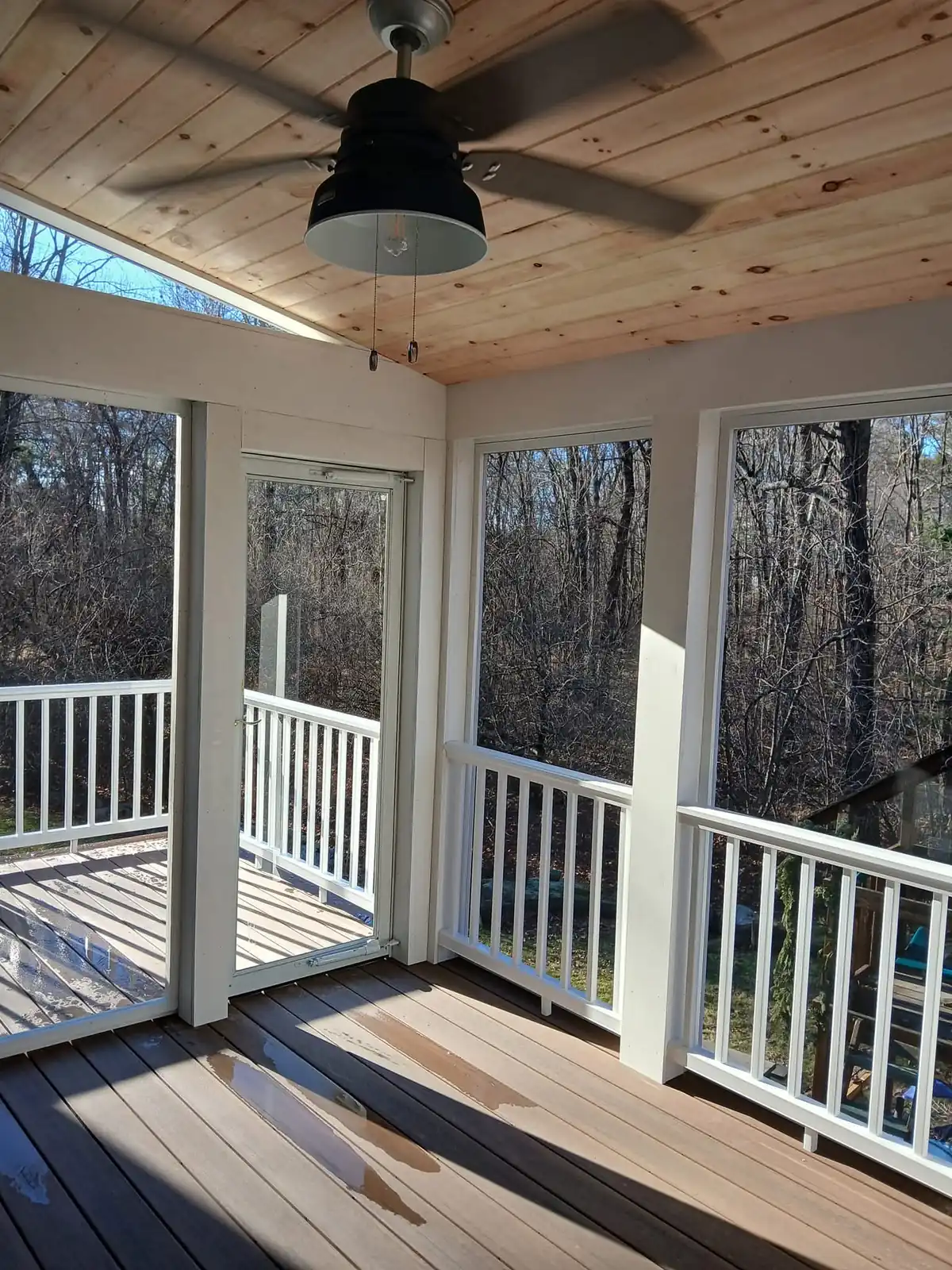
A lanai only works if the bugs stay out. That sounds obvious, but we get called out to fix lanais every year where the screen is fine and the mosquitoes are still getting in. Almost always, it is the small stuff: the gap under a door, an unsealed corner, or the wrong mesh for what is flying around here.
Pick the mesh before you pick anything else
Standard fiberglass screen at 18 by 14 stops mosquitoes and houseflies. It does not stop no-see-ums, and we have plenty of those around water and shaded low spots.
If you are anywhere near a pond, a creek, or heavy tree cover, step up to a tighter mesh. You give up a little airflow and a little visibility, and you gain evenings you can actually sit outside. Pet resistant mesh is worth it if you have a dog that leans on screens, because a single torn panel undoes the whole enclosure.
Doors are where most lanais fail
A screen door with a bowed frame or a worn sweep leaves a gap you can see daylight through. Bugs find it immediately.
Put the door where traffic naturally flows, not where it was easiest to frame. If people have to walk around furniture, they prop it open. A self closing hinge with a decent closer, a full length sweep, and a latch that actually catches will do more for bug control than any upgrade to the screen itself.
Seal the perimeter, top and bottom
The two places we find gaps are where the enclosure meets the house and where it meets the slab. Roofs are rarely dead flat, so there is often a wavy gap along the top plate. Slabs slope for drainage, so there is often a wedge-shaped gap at the bottom.
Both need to be closed properly with trim and flexible sealant, not stuffed with foam and forgotten. On existing concrete we scribe the bottom rail to the slope instead of forcing a straight rail onto an uneven surface.
Framing that survives our weather
Aluminum framing is light, will not rot, and handles humidity without complaint. Wood framing looks warmer and ties in better with a wood deck or a wood ceiling, but it needs to be detailed so water runs off instead of sitting on a flat top edge.
Either way, the screen spline channel matters. Cheap channel lets spline creep out over a few hot summers and the panel starts to sag. Sagging panels pull away at the corners, and there is your gap again.
Checklist for a bug-tight lanai
- Mesh chosen for the insects on your lot, not the cheapest roll available.
- Self closing door with a full sweep and a latch that catches every time.
- Top plate sealed to the roof or fascia with trim, not just caulk.
- Bottom rail scribed to follow the slab slope.
- Corner posts sealed and screened tight, since corners open up first.
- Ceiling fan or two, because moving air keeps mosquitoes off you.
- Lighting placed low and warm, since bright white light overhead pulls bugs in.
Comfort details worth the money
Fans matter more than most people expect. Mosquitoes are weak fliers, and steady air movement keeps them off you even on a still evening in August.
Light color matters too. Warm, low mounted lighting attracts far fewer insects than a bright fixture in the middle of the ceiling. If you want overhead light, put it on a dimmer.
Finally, think about the floor. A lanai over a bare slab is fine, but a stained or tiled slab makes the space feel finished, and it is much easier to sweep out the pollen we get every spring.
Tying it into the house
A lanai should read as part of the home, not a cage bolted to the back wall. That means matching the roof pitch, carrying the fascia line through, and keeping post spacing consistent with the windows above.
If you are weighing a screened space against an enclosed one, our lanai builds page and our patio work page both show what the finished versions look like when the details are handled.
Roofs, ceilings, and how the space feels
A solid roof over a lanai gives you shade and rain protection, and it lets you run fans and lighting cleanly. An insulated panel roof cuts the heat that radiates down in the afternoon, which makes a real difference in July.
A screened top instead of a solid roof lets in more light and works well under an existing overhang, but it also lets in rain and leaves. On a lot with heavy tree cover you will be sweeping constantly, so we usually steer toward a solid roof around here.
Ceiling finish is worth a thought too. A finished wood or vinyl ceiling makes the room feel like part of the house rather than a covered slab, and it gives you something clean to mount fans and lights to.
Yearly upkeep
Screens last a long time if you keep debris off them. Pollen season here coats everything, and that layer traps moisture against the mesh and the frame. A rinse with a garden hose a couple of times a year handles it.
Check the door sweep and hinge tension every spring. That one minute check catches most of the bug problems people call us about later in the summer. Also run your hand along the bottom rail after a heavy storm season to make sure the seal to the slab is still tight.
If a panel does get torn, replace it early. One open corner is enough to make the whole enclosure pointless, and rescreening a single panel is a small job compared to living with mosquitoes for a season.
Talk to us before you order anything
Most bad lanais were fine on paper. They failed at three or four small connections. Getting those right is the whole job.
If you want yours built so you can sit out at dusk without swatting, send us a message and we will come look at the space.
Looking for Lanais in Tallahassee, FL? Learn more about our Lanais service or get in touch directly.