
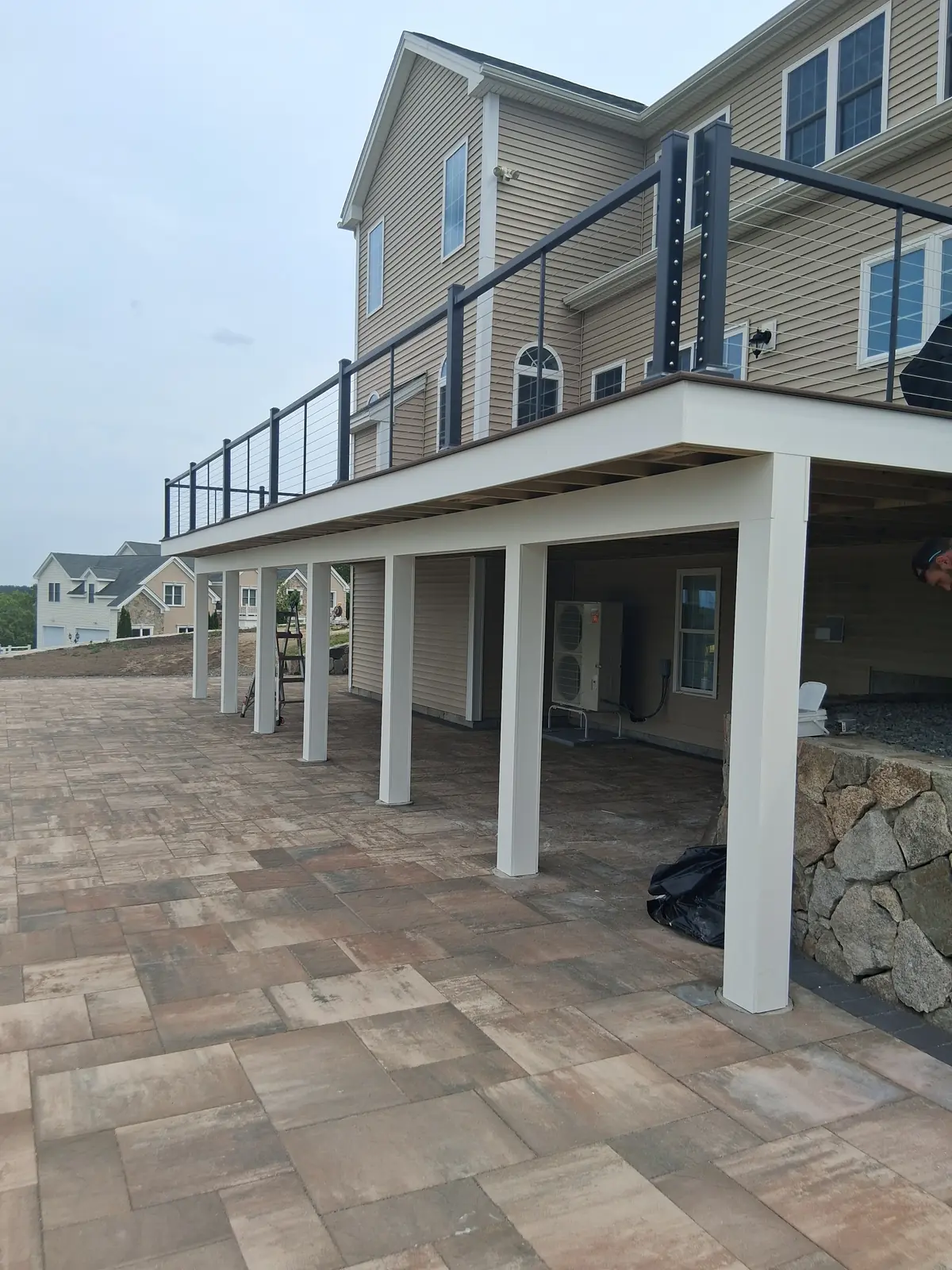
Pavers or poured concrete is a fair question with a real answer, and the answer depends more on your yard than on your taste. Our soil, our rain, and how the ground moves through the year all push the decision one way or the other. Here is how we think about it on a Tallahassee, Florida lot.
Up front cost
Poured concrete is usually cheaper to install. It is one pour, less labor, and a simple material.
Pavers cost more because of the labor. Base prep, edge restraint, cutting, laying, and joint sand all take time. If first cost is the deciding factor, concrete wins and there is no point pretending otherwise.
How each one handles our soil
Our ground has a lot of clay. Clay swells when it is wet and shrinks when it dries, and in Tallahassee it does both several times a year.
Concrete is rigid. When the ground under it moves, it cracks. Good control joints tell it where to crack, but they do not stop it. Pavers are a flexible system. When the base shifts slightly, the individual units move with it and the surface stays intact.
That single difference is why we lean toward pavers on lots with heavy clay, poor drainage, or a slope.
Repairs down the road
A cracked concrete slab has three options: live with it, patch it and see the patch, or break it out and repour. None of them are cheap or pretty.
A settled or stained area of pavers gets lifted, the base gets corrected, and the same pavers go back down. If a tree root pushes a section up, you deal with that section. Keeping a small stack of spares from the original run makes future repairs invisible.
Water and drainage
We get sudden, heavy rain here. A large concrete slab sheds all of it at once, and wherever it goes is where you will have a problem if you did not plan for it.
Pavers let some water through the joints, and permeable systems let a lot through. On a lot that already struggles with runoff, that is a real advantage. Either way, the patio has to slope away from the house. That is not negotiable regardless of material.
Looks and comfort
Concrete can be stamped, stained, or broom finished. Stamped concrete looks good the first few years, then the color coat starts to show wear in traffic paths.
Pavers have color through the whole unit, so wear does not change the look. There is also more variety in size, pattern, and edge detail, which helps when you are matching a brick house or an existing walkway. On heat, light colored pavers generally run cooler than a large plain slab.
How to choose in six checks
- Does water currently pond anywhere near the patio area?
- Is the ground flat, or are you working across a slope?
- Are there mature trees close enough for roots to reach?
- Is the lowest possible first cost the main driver?
- Do you want the option of easy repairs later?
- Does the surface need to match existing brick or hardscape?
Ponding, slope, roots, or a need for easy repair all point to pavers. A flat, well drained yard with a tight budget points to concrete, and there is nothing wrong with that choice.
Base prep is the real story
Whichever you pick, the base decides the outcome. For pavers that means excavating to the right depth, compacting in lifts, and using the right aggregate for our soil. For concrete it means a stable, compacted subgrade, correct thickness, reinforcement where it is needed, and control joints in the right places.
Most failed patios around here were not failed materials. They were rushed bases. It is the part of the job you cannot see and cannot fix later.
Maintenance and how each one ages
Concrete wants sealing if you want to keep it clean looking, and even then it will pick up stains from grills, planters, and the tannins that drip off our live oaks. Mildew in shade is common and comes off with a wash.
Pavers need joint sand topped up every few years and the occasional weed pulled if the sand gets low. Polymeric sand cuts that down a lot. A single stained paver can be swapped, which is a nice option when someone tips over a grill.
Both benefit from keeping leaf litter off through the fall. Wet leaves left on any hardscape here will leave a mark, and under our canopy that adds up fast.
Covered or open
One more thing worth deciding early is whether the patio stays open or gets a cover. A cover changes the foundation requirements, because posts need footings, and it is much cheaper to put those in during the original build than to cut them in later.
Even if a cover is a few years away, we can set the footings now and cap them flush. It adds very little to the project and it keeps the door open. The same goes for running a conduit for future lighting or a fan while the base is still open.
Thinking a step ahead is usually where the savings are on outdoor projects. The expensive part is always going back and undoing finished work.
Talk it over with us
We build both, and we will tell you honestly which one fits your yard once we have walked it. Look at the patios we build for examples, or the decks page if a raised structure makes more sense than a ground-level surface.
Ready to get a real number? Reach out through our contact page and we will set up a visit.
Looking for Patios in Tallahassee, FL? Learn more about our Patios service or get in touch directly.